




Weed Killer
Weed Killer
 SALE
SALE
 SALE
SALE
 SALE
SALE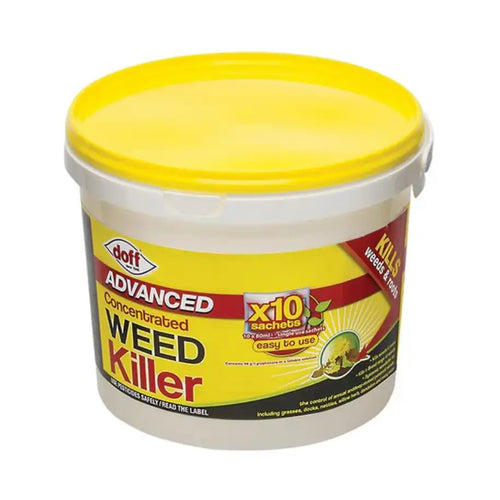
 SALE
SALE
 SALE
SALETotal Weed Killers — Complete Non-Selective Weed Control for UK Gardens
Some weeds don't respond to half-measures. Bindweed that regrows from the smallest root fragment. Horsetail pushing through tarmac from rhizomes half a metre deep. Japanese knotweed capable of compromising garden structures and complicating property sales. On hard surfaces like driveways and gravel paths where there's no grass to protect a total weed killer is the most effective and practical solution available to UK gardeners.
Total weed killers, also called non-selective or broad-spectrum herbicides, work differently to the selective formulas used on lawns. They don't distinguish between the weeds you want dead and the plants you want to keep. Applied to any green growth, they're absorbed through the leaf surface and transported into the plant's vascular system, killing stems, leaves, and roots. That systemic action is what makes them effective against persistent, deep-rooted weeds that surface treatments simply burn back rather than eliminate.
This collection brings together the most effective total weed killers available for UK gardens from ready-to-use sprays ideal for spot treatment, to professional-strength concentrates covering large areas along with guidance to help you choose the right product for your specific problem. If you're not sure whether you need a total or a selective formula, see our guide to selective vs. non-selective weed killers.
What Makes a Weed Killer "Total"?
The term "total weed killer" refers to the herbicide's mode of selectivity or rather, its lack of it. Unlike the selective lawn weed killers formulated to target broadleaf plants while leaving grass unharmed, a total herbicide kills any plant it contacts. This makes total herbicides unsuitable for use on lawns but exceptionally powerful everywhere else.
Most total weed killers available to UK home gardeners use glyphosate as their active ingredient a systemic herbicide that inhibits an enzyme pathway essential to plant growth. When absorbed through a plant's foliage, it travels down through the phloem, reaching roots, rhizomes, and underground storage organs that contact-only herbicides never touch. This is why glyphosate-based products are the preferred choice for treating invasive weeds with extensive root systems.
Some formulations also include pelargonic acid a fast-acting contact herbicide derived from natural plant oils which causes rapid visible browning within hours, even if the full systemic action takes longer to complete. For a glyphosate-free option, pelargonic acid-based products are worth considering, particularly where you want results quickly and are treating annual weeds on hard surfaces.
Where Total Weed Killers Are Most Effective
Driveways and Block Paving
Weeds growing through block paving and tarmac driveways are one of the most common uses for total herbicides in UK gardens. Annual weeds like hairy bittercress and groundsel can be dealt with by almost any product. The more stubborn problem is perennial weeds particularly those with rhizomatous root systems that establish themselves in the gaps between blocks and push up through cracks in tarmac.
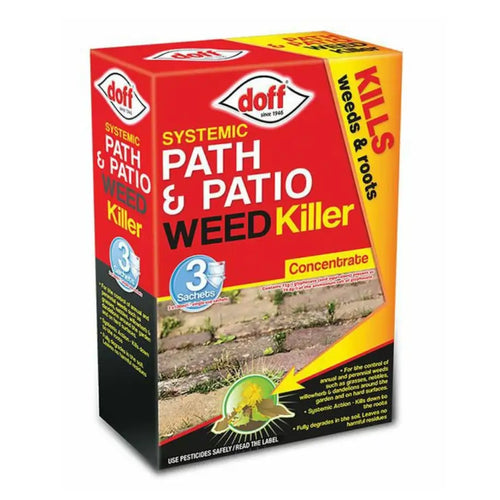
For driveways and hard standings, a glyphosate-based total weed killer applied to actively growing weeds in spring or early summer will give the most complete kill. Many path-formulated products contain a residual element that reduces regrowth over the following weeks. Our path, patio and driveway weed control range includes both glyphosate and pelargonic acid options suited to hard surfaces.
Application tip: Apply on a dry day when no rain is forecast for at least six hours. Glyphosate needs time to be absorbed through the leaf surface before rain can wash it off. Morning applications in calm conditions reduce the risk of spray drift onto adjacent lawn or border plants.
Gravel Paths and Gravel Driveways
Gravel areas are notoriously difficult to keep weed-free by hand. A total weed killer applied with a low-pressure sprayer set to a coarse droplet can treat large areas quickly. For gravel specifically, products that combine glyphosate with a residual element provide better long-term control. Weedol Path & Gravel Concentrate Tubes use pelargonic acid and are particularly effective on gravel, breaking down naturally in soil and leaving the area ready for replanting within days.
Patios and Between Paving Slabs
Weeds rooting between patio slabs are a perennial frustration in UK gardens, particularly in shaded areas where moss also accumulates. A total herbicide applied as a directed spray or with a lance into the joints eliminates rooted weeds more effectively than scraping or pressure washing alone. For long-term management, re-pointing joints with kiln-dried sand after weed treatment significantly reduces future ingress.
Waste Ground and Overgrown Areas
When clearing a neglected plot allotment, building plot, or garden taken over by brambles and nettles a total weed killer is the most practical starting point. For brambles and woody scrub, the Vitax SBK Brushwood Killer contains triclopyr, which is considerably more effective than standard glyphosate on established woody growth. The SBK range also includes a 4-litre concentrate version suited to larger areas of scrub clearance.
Tackling Invasive Weeds: What You Actually Need to Know
Japanese Knotweed
Japanese knotweed (Reynoutria japonica) is one of the few weeds in the UK with legal implications for property owners. Allowing knotweed to spread onto a neighbouring property can result in legal action, and mortgage lenders routinely require evidence of active treatment before approving loans on affected properties.
Effective treatment requires a high-concentration glyphosate-based total herbicide applied across multiple growing seasons typically three consecutive years. The Roundup Ultra Tough Concentrate is a professional-strength option suitable for this purpose. Products should be applied to actively growing foliage in late summer, when the plant is transporting nutrients downward into its root system, maximising herbicide translocation to the rhizomes.
Horsetail and Marestail
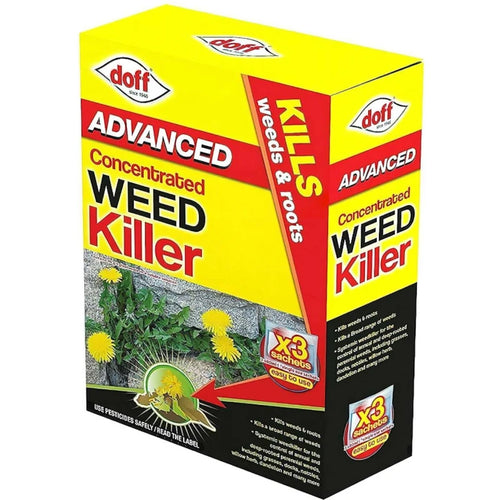
Horsetail (Equisetum arvense) is arguably the most difficult common UK garden weed to kill with standard herbicides. Its foliage is coated with a waxy, silica-rich cuticle that significantly reduces the absorption of foliar-applied products. Standard glyphosate formulations have limited effectiveness unless the foliage is first bruised or crushed to break the protective surface before application. The Doff Advanced Concentrated Weedkiller used at higher concentration is one of the more reliable options for horsetail, though repeat applications over multiple seasons are the realistic expectation.
Bindweed
Both field bindweed and hedge bindweed have white, strap-like underground rhizomes extending several metres into the soil. The challenge is that any rhizome fragment left in the soil will regenerate digging typically makes infestations worse. Glyphosate applied to actively growing foliage in summer is the most effective approach, but bindweed typically requires three to five treatments over two growing seasons before infestations are genuinely suppressed.
Choosing the Right Product Format
Ready-to-Use Sprays
Ready-to-use (RTU) formulations come pre-diluted in trigger spray bottles. The Roundup Fast Action Pump 'n' Go 5L is an excellent RTU option for larger areas, eliminating the need to refill repeatedly. RTU products are the most convenient option for spot-treating individual weeds or treating smaller areas of paving. The trade-off is cost per square metre they're significantly more expensive than concentrates for covering areas larger than roughly 25–30 square metres.
Best for: spot treatment, small patios, individual problem plants, quick touch-up applications.
Concentrated Formulas
Weed killer concentrates are diluted with water before use and offer the best value for treating larger areas. The Doff Advanced Weedkiller Concentrate 1L treats up to 400m² when diluted, making it an economical choice for driveways, paths, and waste ground clearance. The Roundup Ultra Tough Concentrate is a professional-strength option, making up to 50 spray litres from a single bottle ideal for larger infestations or multi-season Japanese knotweed treatment programmes.
Best for: driveways, large gravel paths, waste ground clearance, allotments, repeat treatments over multiple seasons.
Glyphosate-Free Options
For those who prefer to avoid glyphosate, pelargonic acid-based products like the Weedol Path & Gravel Concentrate Tubes offer fast-acting contact control and break down naturally in soil. The Roundup Natural Weed Control Refill 5L is a 100% natural active ingredient option with visible results within one hour explore our pet-safe and glyphosate-free weed killers for the full range.
Brushwood and Woody Weed Killers
For brambles, nettles, docks, and woody regrowth, a triclopyr-based product will outperform standard glyphosate. The Vitax SBK Brushwood Killer 1L RTU Spray is specifically formulated for tough woody weeds and is grass-friendly it won't harm lawns when directed correctly. For larger scrub clearance, the SBK 4L concentrate is available. Browse the full SBK Brushwood Killer collection for all sizes.
Safe Use: What to Know Before Applying
Total weed killers are among the most widely used pesticides in UK gardens, but responsible application matters both for safety and to avoid damaging plants you want to keep.
Before applying:
• Read the product label in full, including the MAPP (Ministerial Approval of Pesticide Products) number confirming UK regulatory approval
• Check wind conditions apply in still air to prevent drift onto garden plants, hedges, or neighbouring gardens
• Wear appropriate PPE: nitrile gloves and eye protection as a minimum; a face shield if using a pressure sprayer overhead
During application:
• Keep spray away from any plants you want to keep total herbicides kill ornamentals, vegetables, and hedging plants just as effectively as weeds
• Avoid application near ponds, watercourses, or drains these products are harmful to aquatic organisms
• Never spray on waterlogged ground or when rain is forecast within six hours
After application:
• Allow the treated area to dry completely before allowing pets or children to access once fully dry, the risk to mammals is negligible
• Keep children and pets away while the spray is wet for pet-safe alternatives, browse our pet-friendly weed killer range
• Do not cultivate treated soil for at least two to four weeks; disturbing the soil allows untreated rhizome fragments to resprout
• Treated annual weeds show visible wilting within 24–48 hours; established perennials may take two to three weeks to show full effect
When to Apply Total Weed Killers in the UK
Timing matters significantly with systemic herbicides, and UK weather patterns create specific application windows that don't apply in warmer climates.
• Spring (April–May): Good for first treatments on actively growing annual and perennial weeds. Glyphosate is most active above 10°C and significantly less effective in cold conditions.
• Early summer (June–July): The most effective application window for perennial invasive weeds. Plants are in active growth, translocating nutrients rapidly, which carries the herbicide efficiently to root systems.
• Late summer (August–September): A second highly effective window, particularly for Japanese knotweed, when nutrients are moving downward from foliage into rhizomes maximising root penetration.
• Autumn (October–November): Reducing effectiveness as temperatures drop. Useful for annual weed clearance on hard surfaces before winter, but not recommended for perennial invasive weed treatment.
• Winter: Not recommended. Most glyphosate products have negligible activity in cold, wet conditions.
Explore Related Collections
Weed Killers — Full Range All weed control products in one place · | Lawn Weed Killers Selective weedkillers that protect grass |
Path, Patio & Driveway Weed Control Hard surface herbicides with residual control | Glyphosate Weed Killers Systemic glyphosate formulas for total control |
SBK Brushwood Killers Triclopyr-based for brambles, scrub & woody weeds | Pet-Safe Weed Killers Glyphosate-free options for gardens with pets |
Roundup Weed Killers Full Roundup range RTU, concentrates & pump sprays | Pet-Friendly Weed Killers Carefully selected for use around family gardens |
Frequently Asked Questions
What is a total weed killer and how is it different from a lawn weed killer?
A total weed killer is a non-selective herbicide — it kills any plant it contacts, regardless of species. Lawn weed killers are selective herbicides formulated to target broadleaf weeds while leaving grass unaffected. Total weed killers should never be used on lawns. They're intended for paths, driveways, patios, gravel, bare soil, and areas where all vegetation needs to be removed.
How long does a total weed killer take to work?
Results depend on the product, weed type, and weather. Annual weeds typically show wilting within 24–48 hours and are dead within a week. Established perennial weeds, particularly those with deep rhizome systems, may take two to four weeks to show significant effect. Invasive species like Japanese knotweed and horsetail require multiple applications across one or more growing seasons for effective long-term control.
Can I use a total weed killer near my vegetable garden?
No — total weed killers will kill vegetable plants just as effectively as weeds. Apply with a directed spray using a lance or shield to prevent any drift or splash reaching vegetable beds. Wait until the treated area is completely dry before working nearby.
How long should I wait before planting after using a total weed killer?
For glyphosate-based products, the active ingredient is deactivated on contact with soil particles. Most manufacturers recommend waiting one to two weeks before planting. Always check individual product label guidance formulations containing residual soil-active components require longer waiting periods.
Is it safe to use a total weed killer if I have pets?
Once the spray is fully dry typically within one to two hours in normal UK summer conditions the risk to pets is considered negligible. Keep pets off the treated area while spraying and until fully dry. For an alternative that avoids glyphosate entirely, browse our pet-safe weed killer range.
What's the most effective total weed killer for Japanese knotweed?
High-concentration glyphosate formulations are the standard treatment. No single application will eliminate an established Japanese knotweed infestation effective treatment requires systematic application over three or more growing seasons. The Roundup Ultra Tough Concentrate is a professional-strength option suitable for this purpose.
Will a total weed killer work in cold or wet weather?
Glyphosate is significantly less effective below 10°C and requires at least six hours without rain after application to be properly absorbed. Applications made in cold, wet, or overcast